A Close Encounter of the First Time
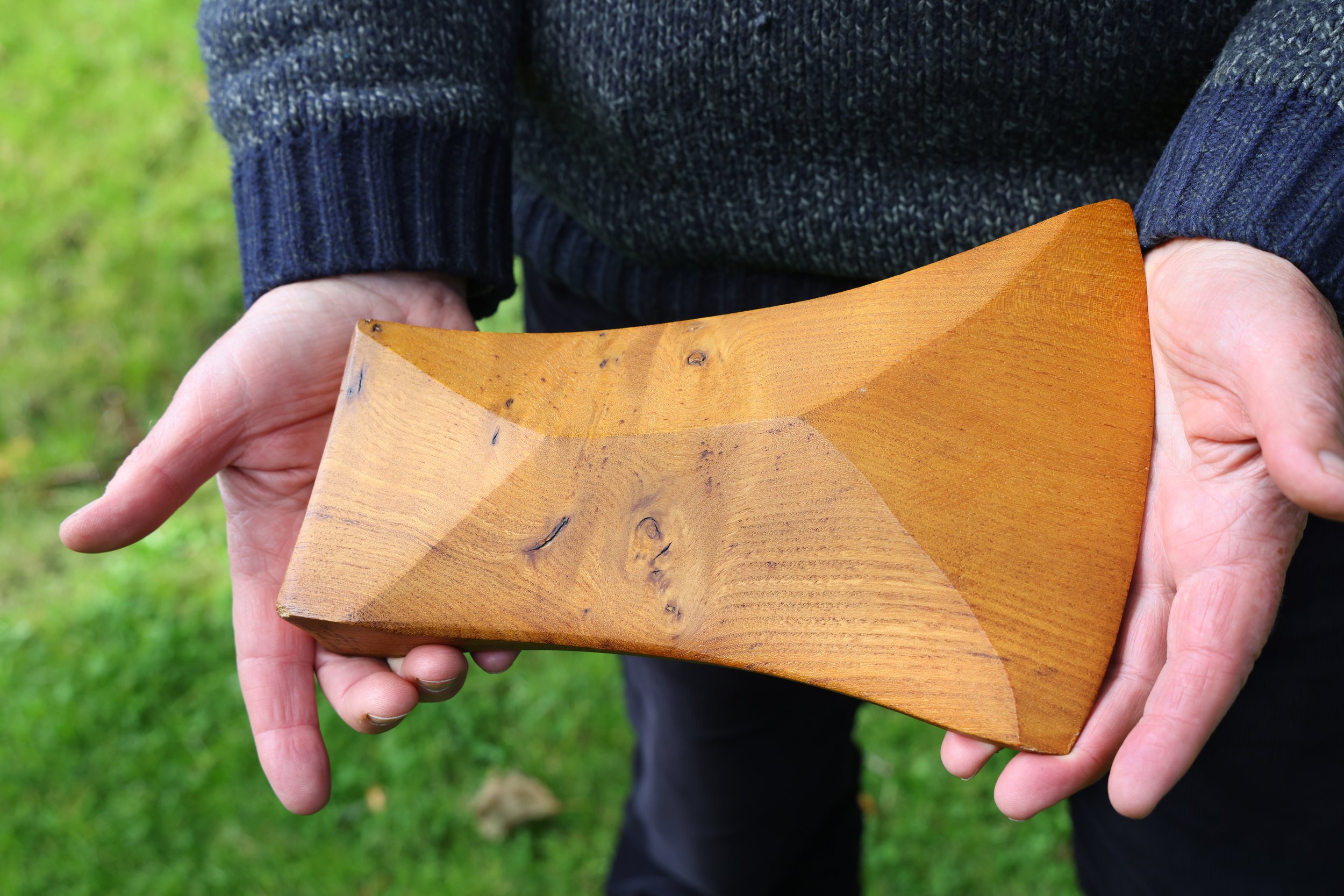
On the date of my birthday, early in 1987, my girlfriend gave me a wooden axehead, a beautiful object and signed by the maker, Tim Squiggle. As I am a forester, it was a thoughtful present. But an axehead, made out of wood, really? A chocolate teapot came to mind.
I had to find out more. We went back to the local gallery, where she had bought the axehead. We found out that the squiggle was actually Stead and that Tim Stead lived locally in Blainslie. We phoned him up and got invited round to Tim and Maggy’s amazing house, the Steading. We had the customary jaw dropping moment as we climbed up the few steps into the main room. If you haven’t experienced this yet, book a tour.
Over a cup of tea, not from a chocolate teapot, Tim explained his idea behind Axeheads for Trees. He also explained the logic of a wooden axehead but that’s a story for another day. Tim, it turned out, was an accomplished furniture maker and sculptor with his own unique style. He specialised in utilising large pieces of hardwood, especially from elms which had succumbed to Dutch elm disease and were littering the Borders at that time. People could hardly give them away but Tim was delighted to take them and to add incredible value to them, creating beautiful objects.
So Tim, being a true conservationist with a big heart, wanted to put something back and plant some trees for the future. He carved a wooden axehead for each day of the year in 1986 and a few more besides. He then sold them to people like me, or rather my girlfriend, to raise funds for the project.
Except there wasn’t any project. Yet. But there soon was as other axeheads winged their way into people’s lives. It turned out that Tim and Maggy knew lots of enthusiastic tree people, which was just as well in the days before social media. Meetings were called and people met around one of Tim’s beautiful tables in the Steading, just as the Tim Stead Trust Board meets round a similar table today. Some of those same people are still around today, others have sadly passed on.
Fuelled with tea, coffee and sometimes red wine, ideas flowed. Instead of buying a bare field and planting it with seedlings, why not buy an existing wood plus bare land and expand the wood? You could build things in the wood, put up swings, aerial walkways. You would need water to encourage water-loving species and rich wildlife. The trees could be thinned out for timber to make useful objects and for firewood, to reduce our dependence on fossil fuels. A woodland for multiple benefits- for future timber, for wildlife, for education but mainly for fun, and a warm fuzzy feeling.
After a few meetings, we decided to launch the idea on the world, or at least the central Borders, by holding a meeting in the Blainslie Village Hall. We discussed all the benefits of broadleaved woodlands, at home and overseas. We drew a sketch of what it would look like. Two streams converging in the middle of a woodland, a variety of tree species and stands, an island of diversity in an open landscape. Stepping back from the sketch, it looked like a heart. That seemed appropriate. Now where to find it?
Donald McPhillimy
