Tim Stead's Towers of strength, Giles Sutherland.
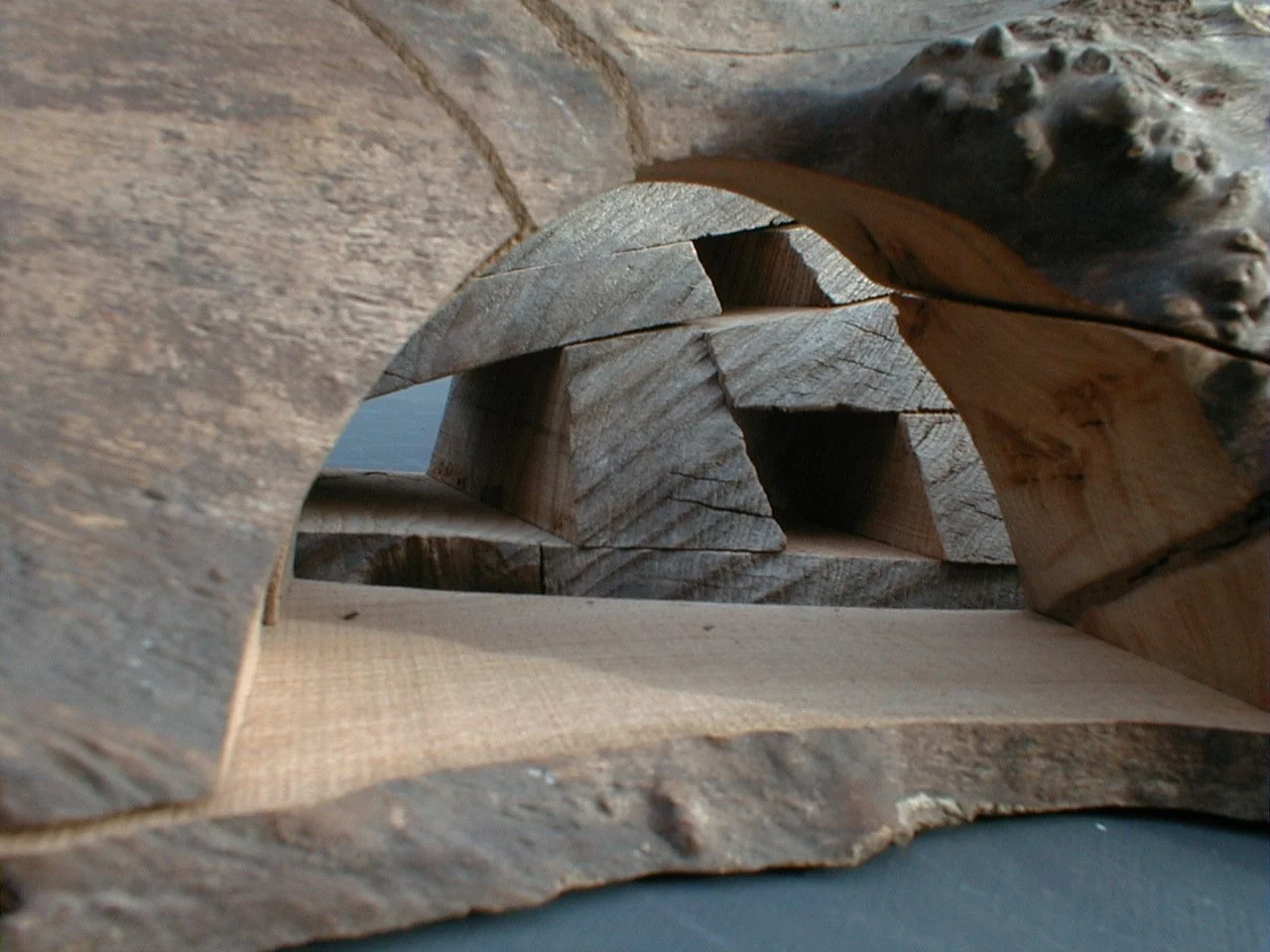
A review by Giles Sutherland of ‘TOWERS’ a collection of poems written by Tim Stead.
TIM STEAD, the furniture maker and sculptor, died on April 21, 2000. He was 48 years old. He had suffered from cancer for many years. The illness progressively sapped his physical vitality and, in its final stages, left him bed-ridden and too weak to move. Working with wood, particularly the bulky and dense cuts of elm and oak so favoured by Tim, was a necessarily demanding task. Precluded from such involvement, he turned to other ways of working.
Tim had expressed himself in writing since art school days, but this had never seen the light of day, either because of modesty or the need to preserve a self-intimacy. He was also an assiduous photographer of his own work. These two modes of expression began to happily combine and coalesce when Tim, for years an avowed technophobe, began to see the potential of computers and digital photography as a serious creative medium. The result is a series of poems and photographs which give insight into the creative process and Tim's inherent need for self-expression.
As one might expect, the poems all written between 1998 and 1999 deal in part with the miraculous nature of Tim's chosen sculptural medium: wood. But Tim was omnivorous and eclectic in his interests: anthropology, ethnography, geology and the life sciences all contributed towards his understanding of and passionate interest in the world around him. Many of these concerns are given voice in the poems. Split Slice Split Slice, for example, draws parallels between the growth of a tree and geological process:
Tapping a fissure in the rock
it breaks along its weakest line
light touches the twin surfaces
for the first time in millions of years
opening a tree
reveals the warm colours of summers gone by
dark lines of winter
pale lines of summer
each year recorded and sunlight stored
to be released again
as heat remembered.
There is a distinct non-literary quality to these poems, almost a naiveté; and they are, in some ways, all the more attractive because of this. In their formal qualities they resemble most the work of e. e. cummings, a poet Tim greatly admired.
The process of their composition finds a parallel in Tim's working methods with wood, as Maggy Stead points out in her introduction: "He wrote like he drew: he would start with a line, which would lead to a drawing. The same with his sculptures....The same for his writing..."
But the poems reveal a more private self than Tim's sculpture or furniture could ever disclose. There are hints of self-doubt and self-mockery; Pool Fool suggests a man less secure than his public persona suggested:
Reflected in a puddle
a face looking down
at itself
a film of rainbow petrol
a leaf blows across one eye
the foot splash
shatters and distorts
the image
There is also anger and despair, well-aimed at the bureaucracies which were unable to categorise and contain a man who crossed disciplines and polite boundaries, both aesthetic and political. The title of Thought Distort Contort Report perhaps says it all, but the lines themselves breath frustration:
Grants make liars of us all
anchored to the aim and idea
the simple must be made more colourful
and complex....
Tim faced his own death with a stoicism and humorous courage I imagine few of us could muster. His sense of being thwarted by something entirely outwith his control - but yet a thing within him and part of him - was, I think, overpowering. Yet even in his own terminal decline, he found inspiration and interest, as the last poem in this sequence poignantly states:
Blood flowing into my veins
from a suspended plastic bag
blood that flowed through someone else
perhaps a man
perhaps a woman
through every tiny corpuscule
through the mighty heart muscle
so intimate
so clinical
yet
so distant
From artwork Issue 107 May/June 2001