
Nichola Fletcher -
Saving The Steading
Ever since Tim’s untimely death in April 2000, the future of The Steading had been a concern. Murmurings of setting up a special trust had been made but naturally it took some time for Maggy - Tim’s widow - to feel ready to let go of this huge part of her life.
But as time went on, keeping everything going through the vagaries of Scottish winters became increasingly onerous, and Maggy decided she needed to return to France to be close to her mother and sister.

In 2013 The Workshop of Tim Stead was taken over by Maggy’s employees and became the Wood Neuk, now run by Tim’s former apprentice, David Lightly. Much of the huge collection of Tim’s work was held in storage. But what to do about The Steading and its priceless contents? And who would care for Tim’s collection and archive?
Reluctantly, in 2014 Maggy decided to put The Steading up for sale and called in a local estate agent. Like most people visiting The Steading for the first time, he was stopped in his tracks as soon as he entered. And after a long pause, said, ‘This is far too important to sell - it would get broken up and destroyed. Leave it with me.’
As a result, a steering group was formed that commissioned a study to recommend options for going forward. One of these was to form a charitable trust to raise the money to purchase The Steading and Collection.
In the autumn of 2015, I had a phone call from Maggy asking if I would be prepared to come down to The Steading as she wanted to start a charitable trust and would I consider being a trustee, perhaps even the Chair? I said ‘yes’ – willingly - to the first, but ‘no’ to the second. We had an interesting group around one of Tim’s tables and between us we formed the Tim Stead Trust … and somehow, I ended up as Chair. Maggy told us that she had enough to live on for five years, so 2020 was our deadline. The clock started ticking.
For the next five years, we worked away, coaxing funding and support wherever we could. We recruited more trustees: lawyers, accountants, planners, foresters, journalists - everyone contributed their utmost and we are so grateful for their input.
We had some wonderfully encouraging supporters who kept us ticking along – one example was the late Hugo Burge of Marchmont, who was immensely generous in both funding and encouraging us to keep going. We had several small grants from the Scottish Borders Council for touring exhibitions and other projects. The Art 360 Foundation funded a professional archivist to research Tim’s archive. We tried the National Trust for Scotland who were very encouraging but did not commit; we applied for wind farm and landfill money without success; we employed a fundraiser; we then had discussions with other fundraisers. What did we not do? We didn’t raise the money.
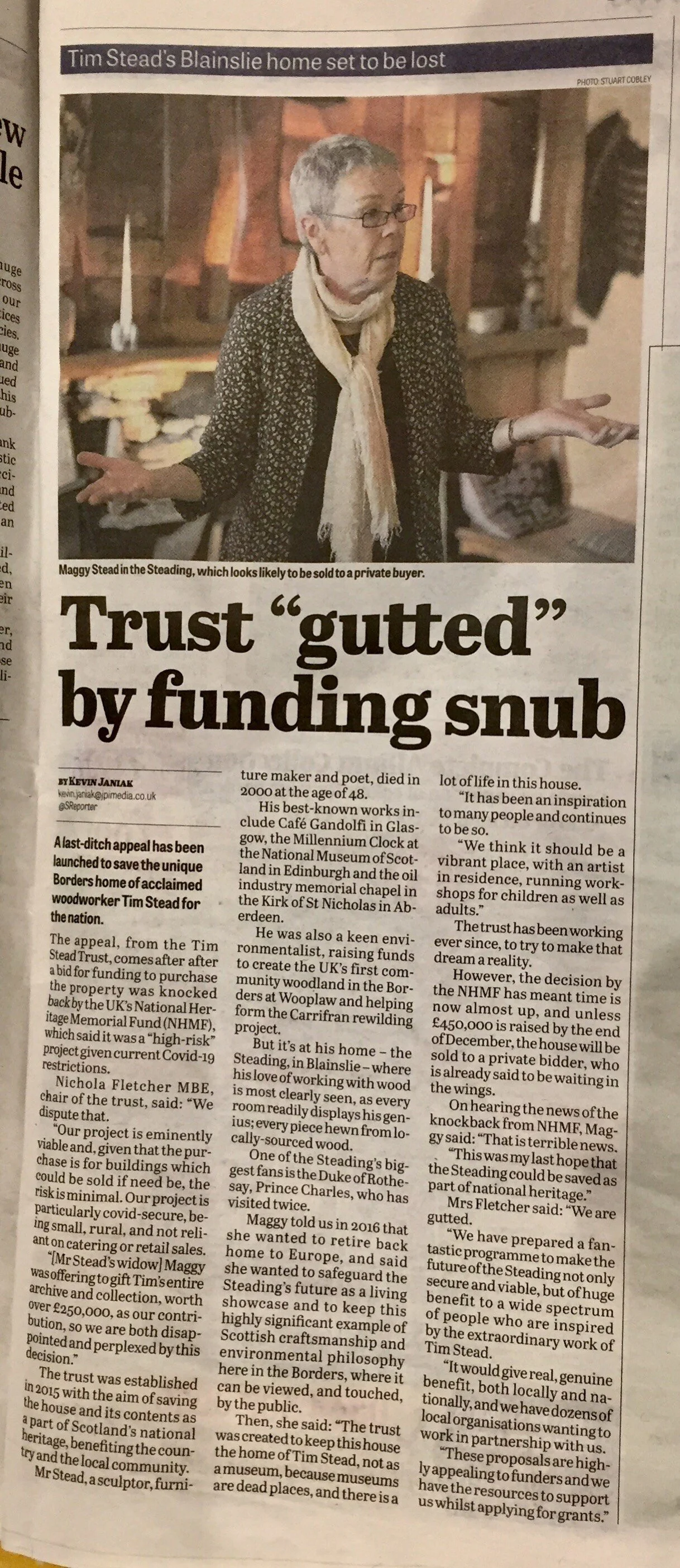
The Deadline
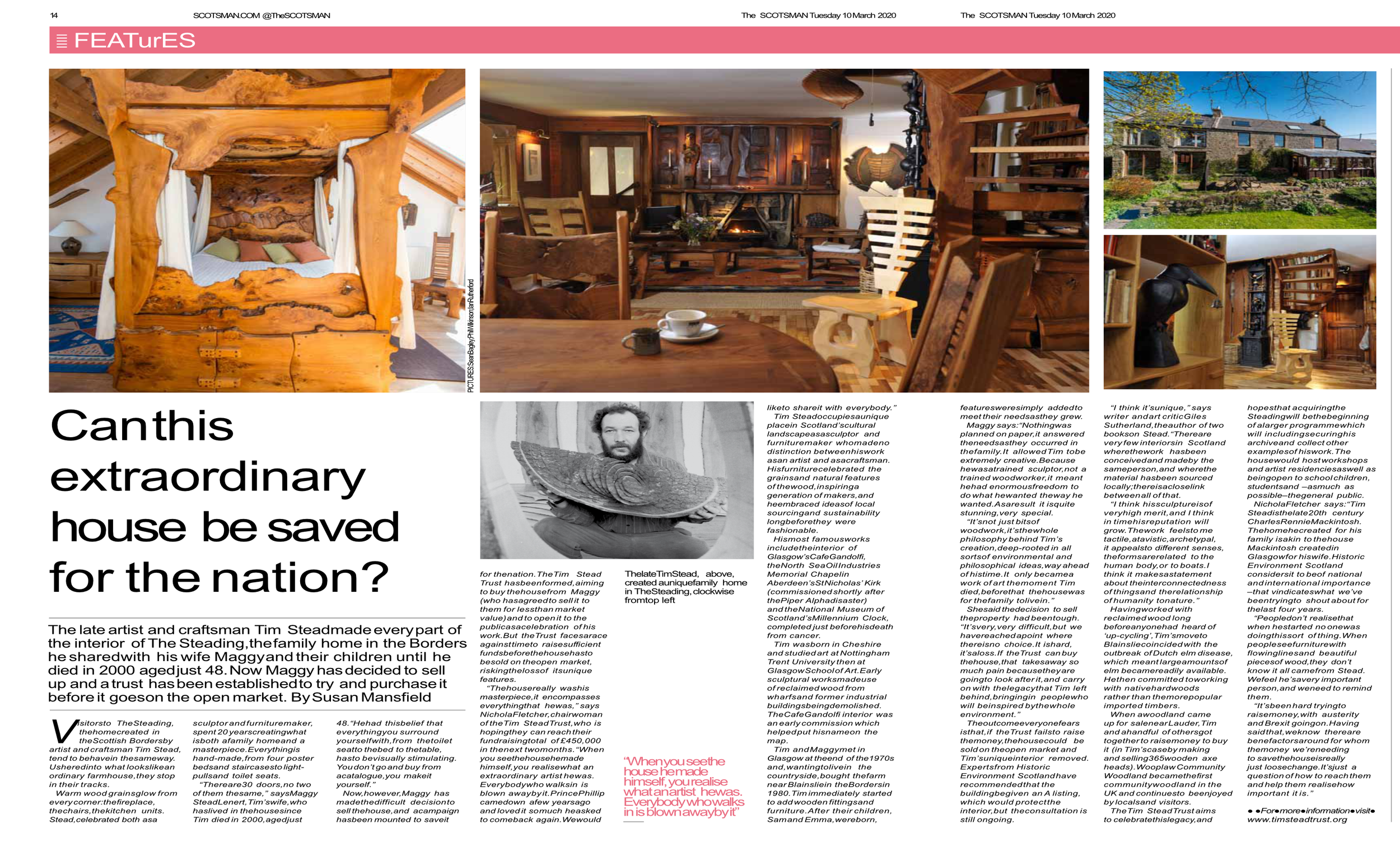
As our deadline came perilously close, we decided that if we could make The Steading a listed building then that at least might save it from being dismantled. So we contacted Historic Environment Scotland (HES). They were very encouraging and visited The Steading. Like everyone else, they were amazed by this unique sculptural house and immediately sent down a photographer to record everything. So at the very least, The Steading was recorded for posterity in the HES National Archives.
A month or two before the Covid pandemic locked everything down, HES contacted us with their verdict. The Steading was designated as a Category A Listed building, meaning it is considered to be of both national and international importance. Their glowing report can be read here. This was a huge step forward. We had credibility. We persuaded the director of Creative Scotland to visit, and she said to come back to them once we’d purchased The Steading. Maggy and I negotiated the loan of one of Tim’s sculptures to the Scottish Parliament. People started to take notice.
But we also had lockdown. And only forty thousand pounds in the bank. In early 2020, with our November deadline coming ever closer, we decided to apply to the National Heritage Memorial Fund (NHMF) which is supposed to be a fund of last resort for significant buildings and works of art. The application process is arduous. And lengthy. We were encouraged by the support of the Art360 team who helped us weave our way through the requests that seemed to come weekly. The application was submitted on time and we were promised an interim result in September. Nothing came. We kept asking. And asking.
Eventually, in early November, I received a brief email to say that NHMF would not fund our project. No reason given. The end of the road. We all felt stunned and crushed. Maggy said her money had run out; she really would have to put the house on the market. But one trustee said, ‘It’s not over till someone else has bought The Steading.’ So we took a deep breath, wrote the most heart-wrenching press-release we could muster, and then pulled in every media and PR contact we could think of. Off it flew, into the ether. And, despite several people showing an interest in purchasing the building, Maggy bravely took it off the market and prayed for a miracle.

Finally Funded
Two days later, one of our supporters rang up and said she had a family trust and would like to pledge £50,000 plus £10,000 of her personal money. Result! Only another £390,000 to go. Two days after that, I was driving down the M74 in thundering rain when my mobile phone rang, and through the deluge I heard the voice say something about Tim Stead. I yelled that I would ring them back.
When I did, the voice asked, ‘What’s all this about Tim Stead? How much do you need and how much have you got?’ I told him £450,000 and we had £40,000 with a pledge of £60,000. With barely a pause, he told me that if we could match it, then he would give us £250,000. Just like that. It was fortunate that I had stopped driving to phone him back. He was as good as his word and did much to promote our cause too. His generous gesture meant that The Steading had a future - it could do good things for people.
Another press release went out with the challenge – Can we match the amazing offer of £250,000? And for the next eight weeks the money came pouring in. A professional fundraiser worked pro bono, researching and writing applications for me to personalize, and I became a bit of a funding junkie, getting slightly twitchy if two days passed without another £10-20,000 coming in. Everyone rallied round and word got out. An aunt told her nephew, ‘put your hand down the back of your sofa’ He found £10,000 for us. The William Grant Foundation gave us two grants; one to help us after we had acquired the building.
By the beginning of February 2021 we were approaching our target so, as advised, we launched a prize draw crowd-funder that we had prepared. And within two weeks we had done it. A huge, collective achievement of people who believed in Tim Stead’s legacy. Interestingly, all the purchase money came from private individuals and family trusts; none from public bodies. And we realised that this was very much in the spirit of Tim Stead who, like me, found the machinations of trying to fit a project into a funding application to be a dispiriting process. It took six months for all the legalities to go through, but that September, we congregated at The Steading and had a celebratory handover of the keys. Actually, Maggy handed us a whole basketful of random keys which had accumulated over the years. It didn’t matter – we were delirious with joy. The Steading was saved.
You can follow the whole of this story in Trixpix Media’s film Tim Stead, Magician in Wood. Latest screenings are available on her website →